| |
 General
Information General
Information
Pearl, being one of the ancient commodities in market, was also
a kind of tributes to the Emperors of Imperial China. In the
modern world, pearls are favourite collection of ladies and
gentlemen in the upper level.
The fascinating
round pearls attract numerous admirers in social gatherings,
as well as interests aroused by their shapes and colours.
Having cultivated by different types of oysters, they can
be classified as follows:
- White
South Sea Pearl
Cultivated by White Lipped Oyster (Pinctada Maxima) with
nucleus inserted, mainly white in colour also in natural
colours like golden yellow, originated in Australia.
- Black
South Sea Pearl
Cultivated by Black Lipped Oyster (Pinctada Margaritifera)
with nucleus inserted, black in colour, originated in French
Tahitian Islands, also called Tahitian Pearls.
- Sea
Water Pearl
Cultivated by Akoya Oyster (Pinctada Martensi) with nucleus
inserted, mainly white in colour, originated in South China
Sea or Sea of Japan.
- Freshwater
Pearl
Cultivated by Triangle Oyster (Hypriopsis Cumingii) no nucleus
inserted, originated in rivers of Eastern China at Yangtze
River.
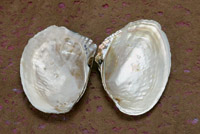 Oyster
Hypriopsis Cumingsii
Oyster
Hypriopsis Cumingsii |
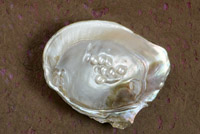
Oyster
Cristaria Plicata
|
Characteristics
of Chinese Freshwater Pearls
 Colour Colour
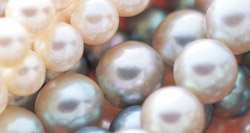
Triangle Oyster is rich in colours, which are caused mainly
by the related colours for mother of pearl used in inserting
slices of mantle tissues. The Triangle Oyster is featured
with natural layers of colours, such as white, silver grey,
pink, orange, yellow and purple. Different water contents
may affect colours to some extent. In this aspect, the rich
in colours freshwater pearls are different from sea water
pearls.
- Shape
-
Using non-nucleus insertion method, freshwater pearls
can be raised in various shapes, such as round, semi-round,
potato, rice, short rice, long rice, water drop, flat,
twin face, quad face, bread and etc.
- Biwa
slice insertion technique:
This technique yields pearls with pipa shape, long or
short stick, long or short slice and etc.
- Nucleus
insertion technique:
This technique yields pearls with round, square, rectangular,
rhombus, button and etc.
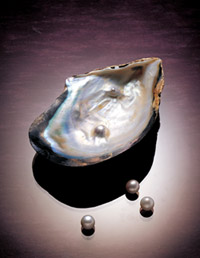 Certain
Aspects on the research of Freshwater Pearls Certain
Aspects on the research of Freshwater Pearls
- Market
Market The prices of pearl products seemed to be stable
at the beginning of 2004. However, owing to an increase
of cost in the international raw materials, which increase
production cost as well, the prices of pearls are tending
to be higher in the near future
Some
jewellers are convinced to use freshwater pearls to replace
Akoya pearls and South Sea pearls, because their qualities
are almost the same. Freshwater pearls are proved to be
suitable gems for jewellers indeed, regarding their quality,
quantity, size range, shape types, colour choices and
cost, and so on.
- Promotional
Strategy
The good quality, non-nucleus freshwater pearls are considerably
high in prices, with fascinating colours attracting more
interests of the consumers.
In the near future,
we have to innovate new promotional strategies to arouse public
attention to establish an effective market for freshwater
pearls.
This situation
implies another boom in the sales of Chinese freshwater pearls
in coming future.
|
|


